The Power of Two
Twin organ recipients are breathing life into Japanese transplant advocacy
By: Jessica Ocheltree | Nov 19, 2009 | Issue: 817 | One Comment | 2,432 views
Photos Courtesy of The Power of Two and Lori Paladino

Photos Courtesy of The Power of Two and Lori Paladino

Take a deep breath. Can you feel your lungs expanding inside your chest as the delicate sacks called alveoli pluck oxygen from the air to power the cells in your body? Now breathe out, and let your lungs effortlessly switch from gathering O2 to expelling CO2, a gas that would otherwise build up and send you convulsing to your death. Have you ever stopped to think about what a miracle working lungs are?

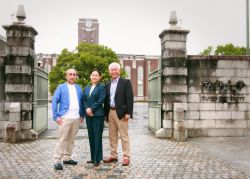
Anabel Stenzel and Isabel Stenzel Byrnes have. They struggled for decades to get their lungs, crippled by cystic fibrosis, to do the very thing we all take for granted. Now in their 30s and with donor lungs helping them breathe easily, they’ve come to Japan to try and break down some of the cultural barriers against organ transplantation.

Ana and Isa, as they are known, are something of an anomaly. They were born to a Japanese mother and German father. Cystic fibrosis is a genetic disease which only presents when both parents are carriers. Given the disease’s extreme rarity among Asians and the unlikelihood of identical twins, their physicist father calculated that there was a 1 in 1.8 billion chance of having half-Japanese twins with CF.

The sisters spent much of their young lives undernourished, enduring long hospital stays on IV antibiotics to fight killer bacteria. Although they weren’t expected to live through adolescence, they went on to attend prestigious Stanford University. But every day they had to strike a balance between optimism and realism.

“How were we going to live the best life that we could with this weight on our shoulders that maybe we wouldn’t see our high school graduation or maybe we wouldn’t go to college and maybe we wouldn’t even get married?” asks Isa.

CF was slowly killing them. Ana and Isa both suffered drops in their lung capacity in their 20s. They didn’t have the energy to enjoy their lives and became highly dependent on supplementary oxygen. It was becoming clear that they needed to consider the option of donor lungs.

Transplantation is not a cure-all—one doctor has likened it to exchanging one disease for another. Recipients must spend the rest of their lives on a cocktail of immunosuppressant drugs, which puts them at risk of infection and a long list of side effects. In the end, both Ana and Isa decided to take the risk, receiving new lungs in 2000 and 2004, respectively. With those precious gifts, they had a new capacity for life.

“I filled my days with bountiful energy to live hard—to see and do as much as I could to make up for lost time,” says Ana.

The sisters have indeed been living hard. In addition to fulfilling personal goals like climbing the intimidating Half Dome in Yosemite Park, they give lectures, lead workshops and participate in awareness-raising events, including the US Transplant Games. After co-authoring the memoir The Power of Two: A Twin Triumph Over Cystic Fibrosis, the sisters teamed up with Academy Award-nominated producer Marc Smolowitz (Weather Underground) to make a documentary about the importance of organ donation and CF research, which is tentatively scheduled for release in 2011.

Their trip to Japan last month involved work on the film and promotion for the Japanese version of their book. It was also serendipitously timed, as Japan has recently changed its famously restrictive donation laws, allowing people under 15 to be donors and relaxing the rules for establishing consent.

While celebrating the decision, Ana wonders if it will do much to increase the donor pool, as it provides little funding for education or outreach. “[It’s] a huge step forward. The only problem is now, children are in the same situation as adults in Japan, which means they might wait ten years for a kidney or 20 years for a liver or never get a heart because people don’t want to donate the heart. They’re still in the same dire straits as the adults.”

Still, the twins hope that their efforts and those of locally based advocates can eradicate misconceptions.

“Organ donation is not about taking something from families—it’s about giving them an opportunity to help other people in their tragedy,” says Isa. “We aren’t saying that our lives as recipients are more important than the donor’s lives. That life of the donor is so valuable, but it’s already been let go. Organ donation is the one last act that a person can perform after they have died to help other people.”

To find out more about The Power of Two, see www.thepoweroftwomovie.com. Also see the Japan Organ Transplant network (www.jotnw.or.jp; English and Japanese) or the Japan Transplant Recipients Organization (www.jtr.ne.jp; Japanese).

    Village Voices
    The Japanese Jewish community is small but active, and the Rabbi Mendi Sudakevitch of Chabad Japan is intent on making it more so. His community is building a mikveh, which is a Jewish ritual bath, and they are looking for anyone who is keen to help in any way, regardless of religion, gender, or belief....
    May 14, 2012 | No Comments | 169 views
    Read more »

    Village Voices
    Disaster memorials can be a touchy business. Creating a lasting and moving monument to satisfy a large and engaged community can be almost impossible. One group has hit upon a lovely and eco-friendly idea for a 3/11 memorial, though, which is sure to please. They call it the Sakura Line 311. Organizers plan to plant...
    Mar 28, 2012 | No Comments | 206 views
    Read more »

Share:

Email:

Email This Post

Print:

Print This Post
Rate this
1 Star2 Stars3 Stars4 Stars5 Stars (4 votes, average: 4.00 out of 5)
Loading ... Loading ...

One Comment

  1. Tomoko Kubota | November 19, 2009 at 11:54 am

    These two women are an inspiration for me!

Post a Comment

You must be logged in to post a comment.